Explorist
  • Badge of Excellence
  • Asia,Seoul
  • 2 days (approx.)

  • Pickup offered

  • Mobile ticket

2-Day Busan and Gyeongju Highlights

Busan and Gyeongju are diverse and attractive cities that are closely intertwined with culture and history. Busan "Haeundae" a famous tourist area known to all Koreans today was named after the ancient Shilla philosopher 'Choi Chi-won' (pen named 'Haeun', 'Goun', 'Haebu'), who fell in love with the beauty of the Haeundae area. and also, Woman King Jinseong, the 51st kingdom of Silla, was famous for frequently visiting Busan "Haeundae" Hot Springs to treat her skin diseases. You can enjoy abundant fresh seafood's in Jagalchi, Busan, learn about modern history at Gukje Market and Gamcheon Culture Village, leave unforgettable memories at Haeundae, a beautiful sea of ​​romance, and also enjoy the Korean sentiment where the past and the present coexist through Busan and Gyeongju, which are feeling the Korean life, cultural, tradition, history, natural landscapes for your 2 days of the trip.

What's Included

  • Private transportation
  • Busan, Gyeongju free transport service after the tour
  • Free pickup and drop-off
  • Guide + driver or driving guide
  • Entrance decides to go to places and pay yourself on the spot
  • Gas + toll + parking fees
  • Meals
  • Hotel, Airbnb, Accommodation
  • Busan Tower KRW 12,000/per Songdo Beach cable car KRW 22,000/per Daereungwon Tomb KRW 3,000/per Wolji Pond KRW 3,000/per

Meeting And Pickup

What To Expect

    Day 1: Busan Highlights
  • I will pick up your location confirmed time and then we will start tour As one of the only ocean side Buddhist temples in all of South Korea, Haedong Yonggungsa is also one of the country’s most unique places of worship. With more than 600 years of history, the temple is known for its unusual location and mystical occurrence

    Duration: 1 hour

    Admission Included: NOT_APPLICABLE

  • Haeundae Dalmaji-gil Road

    Called Busan’s Montmartre, Dalmaji-gil Road is famous for its views of the blue ocean, white sandy beach, Camellia forest, and pine tree forest, creating one of Busan’s eight scenic sites.

    Duration: 20 minutes

    Admission Included: NOT_APPLICABLE

  • Haeundae Beach

    Haeundae Beach is an urban beach in Busan, South Korea. Often dubbed one of the country's most famous and popular beaches, it is located in the eponymous Haeundae District

    Duration: 30 minutes

    Admission Included: NOT_APPLICABLE

  • Dongbaekseom

    Dongbaekseom Island is an island located in Busan, near the famous Haeundae Beach. The island honors Scholar Choi Chi-won. You can visit this island through a long walking path. You will pass by different points of attraction such as the mermaid statue (it represents the legendary heart breaking love story of the princess of Topaz from the Naranda country beyond the Sea. In this country lived a mermaid who was married to the King of Mungungnara. She shed many tears longing for her homeland and reflected on the topaz bead given by her grandmother-in-law), the Nurimaru APEC House, the Carved stone.

    Duration: 30 minutes

    Admission Included: NOT_APPLICABLE

  • Gwangandaegyo Bridge

    The Gwangandaegyo or Diamond Bridge is a suspension bridge located in Busan, South Korea. It connects Haeundae-gu to Suyeong-gu. The road surface is about 6,500 meters long, with the bridge as a whole spanning 7,420 meters. It is the second longest bridge in the country after the Incheon Bridge. ( nature view seaside with marine city town )

    Admission Included: NOT_APPLICABLE

  • UN Memorial Cemetery

    The UN Memorial Cemetery in Korea honors UN soldiers from 16 countries and UN aids from five countries that were killed in battle during the Korean War from 1950-1953. It is the only memorial cemetery in the world dedicated to UN soldiers. While the cemetery originally held up to 11,000 graves, most of the fallen soldiers were repatriated at the request of their families, with only 2,300 graves remaining. The serene park spreads across a grassy plain area of 135,000 square meters. Some notable sites and memorials include: Memorial Service Hall, Memorabilia Hall, two Turkish Monuments, Greek Monument, Australian Monument, British Commonwealth Monument and two ponds.

    Duration: 40 minutes

    Admission Included: NOT_APPLICABLE

  • Oryukdo Skywalk

    Oryukdo Skywalk is located at what was called Seungdumal, meaning a saddle, due to the shape of the point. It was also called Jallokgae by residents and female divers in the area. Iron columns were set up over a 35-meter-high coastal cliff, and a 15-meter glass bridge comprised of 24 glass plates and shaped like a horse’s hoof connect the iron columns. The glass flooring was made by four layers of 12-millimeter glass panels coated with a bulletproof film for a total thickness of 55.49 millimeters, making the structure quite safe. Visitors will be thrilled with the view of the waves while looking down through the transparent floor. The sea stretches out ahead of the skywalk, perfect for a photo op.

    Duration: 30 minutes

    Admission Included: NOT_APPLICABLE

  • Songdo Beach

    Opened in 1913, Songdo Beach is the first beach in Korea. After its golden period in the 1960s and 1970s, the beach became deserted. Those who wished to bring it back to its former beauty joined forces to repair the abandoned beach, making it even more breathtaking than it was in its heyday. With its spotless sandy beach, clear water, cloud trails, and an overwater cable car, Songdo Beach is once again a popular tourist destination receiving over five million visitors per year.

    Duration: 1 hour

    Admission Included: NO

  • Busan Gamcheon Culture Village

    Gamcheon Culture Villiage is formed by houses built in staircase-fashion on the foothills of a coastal mountain, earning this village the nickname "Machu Picchu of Busan." Many alleys that cut through this community are vibrantly decorated with murals and sculptures created by the residents.

    Duration: 1 hour

    Admission Included: NOT_APPLICABLE

  • Busan Tower

    Busan Tower is a symbol of Busan that stands proudly at 69 meters above sea level at a height of 120 meters. The top of the tower is modeled after the baldaquin of Dabotap Pagoda in Bulguksa Temple, Gyeongju. Loved by Busan citizens and tourists alike, the tower offers a stunning night view and plenty to see, such as the Statue of the Great Admiral Yi Sun-sin, the Bell of the Citizens, a flower clock and a bust of the Busan-based independent activist, Baeksan An Hee-je.

    Duration: 40 minutes

    Admission Included: NO

  • Gukje Market

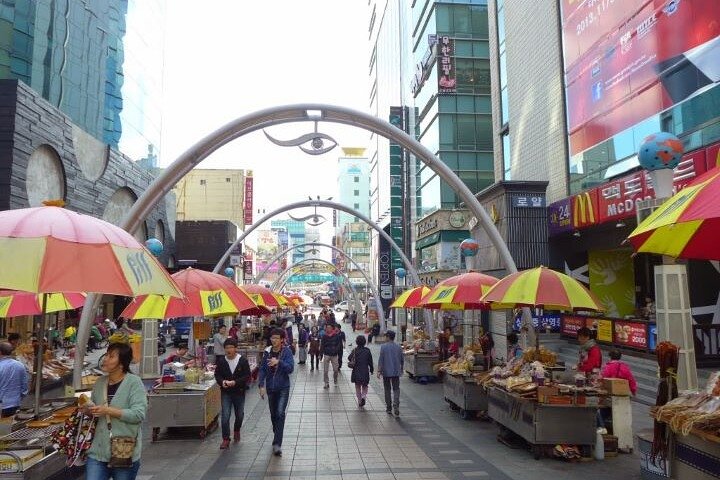
    Originally formed by Korean War refugees, this downtown market has grown into Busan's largest. Here you can find the best wholesale prices for clothing, silk, linen, curtains, bags, glasses, and many imported items. Similar to Namdaemun Market in Seoul, the stores are small and the vendor-filled alleys are narrow. Kukje Market spills out into the streets and continues into Kwangbok-dong & Namp'o-dong. Along its southern boundary is the Jagalchi Fish Market

    Duration: 30 minutes

    Admission Included: NOT_APPLICABLE

  • Nampodong, which is the old downtown area of Busan, literally has it all! It has all the different kinds of brand shops as well as affordable local stores. Between the streets, there are street food alleys

    Duration: 30 minutes

    Admission Included: NOT_APPLICABLE

  • This market represents Busan and is famous throughout the country. Visitors can eat fresh raw fish right at the market. Even nowadays visitors can see women selling mackerel, sea squirts (ascidians) and other seafoods on wooden boxes along the road outside of the market and along the shore. After tour we will return to your start point

    Duration: 40 minutes

    Admission Included: NOT_APPLICABLE

  • Day 2: Gyeongju Highlights
  • Seokguram

    (Gyeongju UNESCO itinerary) Seokguram is an artificial grotto constructed of granite that comprises an antechamber, a corridor and a main rotunda. It enshrines a monumental statue of the Sakyamuni Buddha looking out to sea with his left hand in dhyana mudra, the mudra of concentration, and his right hand in bhumisparsa mudra, the earth-touching mudra position. Together with the portrayals of devas, bodhisattvas and disciples, sculpted in high and low relief on the surrounding walls, the statues are considered to be a masterpiece of East Asian Buddhist art. The domed ceiling of the rotunda and the entrance corridor employed an innovative construction technique that involved the use of more than 360 stone slabs.

    Duration: 1 hour

    Admission Included: NO

  • Bulguksa Temple

    Bulguksa is a Buddhist temple complex that comprises a series of wooden buildings on raised stone terraces. The grounds of Bulguksa are divided into three areas – Birojeon (the Vairocana Buddha Hall), Daeungjeon (the Hall of Great Enlightenment) and Geungnakjeon (the Hall of Supreme Bliss). These areas and the stone terraces were designed to represent the land of Buddha. The stone terraces, bridges and the two pagodas – Seokgatap (Pagoda of Sakyamuni) and Dabotap (Pagoda of Bountiful Treasures) – facing the Daeungjeon attest to the fine masonry work of the Silla.

    Duration: 1 hour

    Admission Included: NO

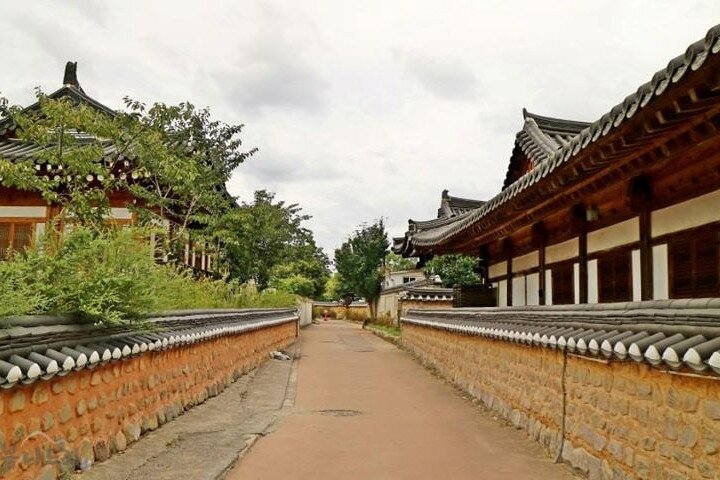
  • Gyeongju Folk Craft Village consists of 40 thatched and tile-roofed houses, lived in by local artisans of traditional arts and crafts skills. Various fields of crafts production including metal, pottery, timber, jewels, hanbok (Korean traditional clothes), and stone crafts can be found in the village.

    Duration: 40 minutes

    Admission Included: NOT_APPLICABLE

  • Large ancient tombs of kings and nobles of the Silla Kingdom can be seen around Gyeongju at the Daereungwon Tomb Complex. There are twenty-three large tombs located here; 13 have been excavated but only 1 (Cheonmachong - tomb of King Michu) is open to the public. The tomb chamber contained a lacquered wooden coffin that had burial goods placed around it. A total of 11,500 artifacts were recovered from the tomb, demonstrating the king's lavish lifestyle. The tomb was excavated in 1973 and is believed to date probably from the fifth century.

    Duration: 1 hour

    Admission Included: NO

  • At Gyeongju Gyochon Village, visitors can see the House of the Gyeongju Choi Clan (Important Folklore Material No. 27) and try some Gyeongju Gyodong Beopju Liquor (Important Intangible Cultural Asset No. 86-3). The village centers around the Gyeongju Choi Clan, a family known to have maintained their wealth for over 12 generations, producing many important people. Visitors can learn about the lifestyle and spending habits that enabled the family to do this. The village is also home to the site of Yoseokgung, the house of Silla Princess Yoseok. Nearby attractions include Gyerim Forest, Naemulwangneung Royal Tomb, and Gyeongjuhyanggyo Local Confucian School

    Duration: 40 minutes

    Admission Included: NOT_APPLICABLE

  • Cheomseongdae Observatory

    Cheomseongdae Observatory, constructed during the reign of Queen Seondeok (r. 632-647), is one of the landmark of Gyeongju. The observatory was built in a cylinder shape at approximately 9 meters in height. The observatory consists of 365 stones, symbolizing the number of days in a year. The rocks are piled in 27 layers symbolizing the 27th ruler, Queen Seondeok, and the days in a lunar month by adding the of two rock layers on top. It stands 9.17m high and the base stone on each side measures 5.35m.The Vernal Equinox, Autumnal Equinox, Winter Solstice, Summer Solstice and the 24 solar terms (also known as the astronomical solar year) were determined by observating of stars. The pavilion stone is believed to have been used as a standard of deciding directions, north, south, east and west. The 362 stones used to build Cheomseongdae represented the 362 days in a lunar year.

    Duration: 30 minutes

    Admission Included: NOT_APPLICABLE

  • Gyeongju National Museum

    Gyeongju National Museum is loved by visitors and residents alike as it houses numerous historical and cultural artifacts of the Silla dynasty (57 BC - AD 935). The museum recently went through renovation, separating into an art gallery, historical artifacts exhibition hall, Wolji Pond exhibition hall, and a planned exhibition space. In addition to improving facilities for visitors' convenience, Gyeongju National Museum is making efforts to contribute to the community and reestablish its identity as a museum by making efforts to provide lifelong learning opportunities and improve management. As a significant cultural center, Gyeongju National Museum not only strives to preserve, exhibit, and research the rich history and culture of Silla, but also to take a leap forward to become a cultural multi-complex center by promoting international exchange opportunities, social education programs, and a variety of special exhibitions.

    Duration: 1 hour

    Admission Included: NOT_APPLICABLE

Additional Info

  • Wheelchair accessible
  • Infants and small children can ride in a pram or stroller
  • Public transportation options are available nearby
  • Transportation options are wheelchair accessible
  • Suitable for all physical fitness levels
  • Please advise any specific dietary requirements
  • At the time of booking Minimum, 2 people numbers apply. There is a possibility of cancellation after confirmation if there are not enough passengers to meet the requirements. In the event of this occurring, you will be offered an alternative or full refund
  • Meet up point: Customers are requested on time and location and we will pick- your up in front of the exit gate with your name picker.
  • Please let me know your total travel luggage before arriving at the airport and train station if you can possible.

Cancellation Policy

    You can cancel up to 24 Hours in advance of the experience for a full refund.

    • For a full refund, you must cancel at least 24 Hours before the experience’s start time.
    • If you cancel less than 24 Hours before the experience’s start time, the amount you paid will not be refunded.
    • Any changes made less than 24 Hours before the experience’s start time will not be accepted.
    • Cut-off times are based on the experience’s local time.
    • This experience requires a minimum number of travelers. If it’s canceled because the minimum isn’t met, you’ll be offered a different date/experience or a full refund.

Starting from

$600.00

Price varies by group size